Dark Cloud, Yakuza, and the RPG Ideas That Crossed the Pacific
The line between Japanese and Western RPGs is more porous than it looks. From Final Fantasy VII to Infinite Wealth, the best design ideas kept crossing it in both directions.
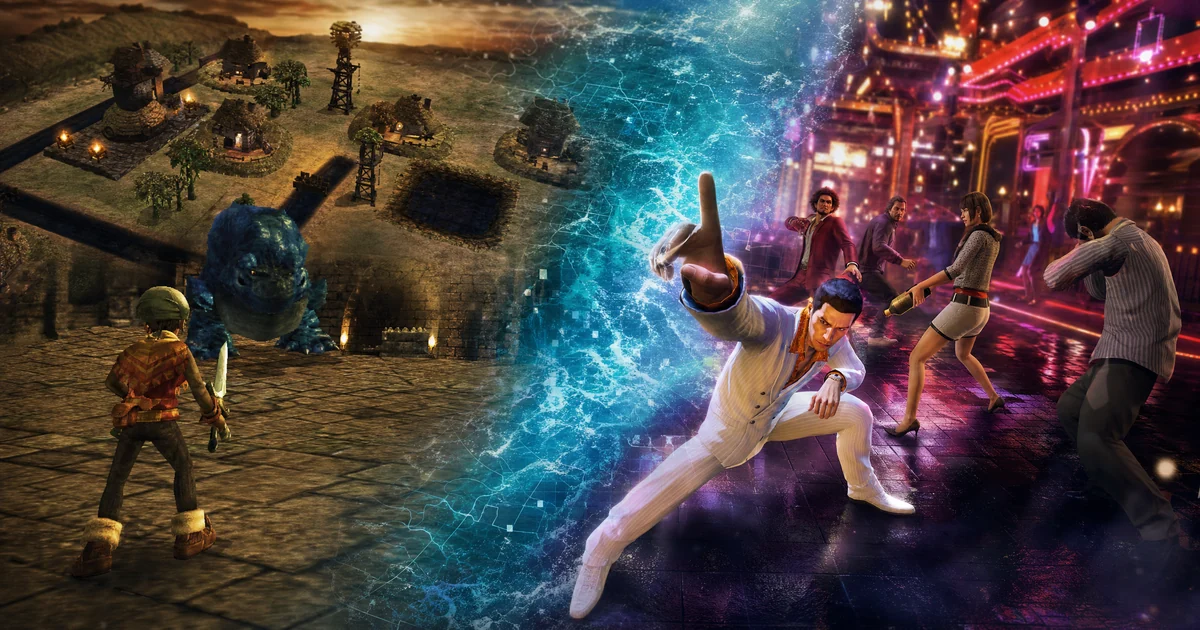
We like to sort role-playing games into two bins. Western RPGs hand you a sandbox and a rulebook. Japanese RPGs hand you a hero and a story. It is a tidy split, and it is mostly a myth. The good design ideas have been crossing that border for thirty years, in both directions, and the sales usually reward whoever crosses at the right moment.
Two games make the point better than any argument. In 2000, Level-5 built Dark Cloud by reaching west, bolting a town-building simulation and randomized dungeons onto a PlayStation 2 adventure. Twenty years later Sega went the other way, ripping the real-time brawling out of Yakuza and dropping in turn-based menus straight from Dragon Quest. One studio chased Western openness. The other doubled down on the most traditionally Japanese system there is. Both bets paid off.
Two ways to draw the grid
Worth being precise about what those two bins mean. A role-playing game is any game where you grow a character through numbers: hit points, levels, stats, gear. Past that shared root, the traditions split hard. Western RPGs, from tabletop Dungeons & Dragons through Baldur's Gate and The Elder Scrolls, hand you the grid and let you draw on it: open maps, dice-like odds, emergent combinations no designer hand-placed. JRPGs keep the grid tighter and more authored: a named hero on a mostly fixed path, the story as the spine, systems built for pacing rather than open-ended simulation. Neither is better. They are two answers to one question: how much of the structure should the player get to see and bend?
The 1990s: one disc opens the border
For most of the decade the JRPG was the dominant flavor of the genre worldwide, and one release set the terms. Final Fantasy VII (1997) put a Japanese, authored, turn-based story in front of a mass Western audience for the first time, carried by Sony's PlayStation marketing and a pile of pre-rendered spectacle. The original and its ports have since passed 15 million copies, the wider Final Fantasy series more than 200 million. In the 1990s, "RPG" in a Western store often meant a Japanese one.
Dark Cloud: Japan reaches for the open world
Level-5's Dark Cloud arrived in Japan in December 2000 and North America in May 2001, an early PlayStation 2 showcase from Sony. It scored 80 on Metacritic and sold past a million copies by 2014, most of them American. What makes it worth pulling off the shelf is how openly it borrowed. The dungeons are procedurally generated, a Western roguelike idea. Weapons, not characters, gain experience, and they wear down and shatter if you neglect them, a durability loop from systems-driven Western design rather than the fixed gear of a typical JRPG. Then comes the part that fits no Western mold at all: Georama, a town-rebuilding mode where you place recovered houses, trees, and rivers back onto the landscape until each villager's very specific wish is satisfied. A curated, authored puzzle stapled to an open-feeling adventure, and somehow it works.
The 2003 sequel Dark Cloud 2 (Dark Chronicle in Japan and Europe) pushed the fusion further and reviewed better still, at 87. It piled on a buildable mech, an invention system driven by in-game photography, time travel that lets your town-building ripple across eras, and a physics golf minigame played inside cleared dungeons. Yes, golf. If that glorious grab-bag is your idea of a good time, you can scratch the same itch in a browser tab today, from simulation and building games to browser action games.
The HD years: the market tilts west
Then the ground moved. The high-definition era, roughly Xbox 360 and PlayStation 3, was where the big Western RPGs found blockbuster scale. Oblivion, Mass Effect, and Fallout 3 sold open worlds and player-authored characters as the modern shape of the genre, and The Elder Scrolls V: Skyrim (2011) became the emblem, with lifetime sales Bethesda's Todd Howard puts above 60 million. Against that, a "JRPG decline" narrative took hold. The genre had not stopped selling, but it looked dated next to those systemic giants, and its own flagship handed critics the ammunition: Final Fantasy XIII (2010) earned the nickname "the beautiful hallway" for trading towns and exploration for a long, gorgeous corridor. The authored grid, for years a JRPG strength, suddenly read to Western players as a cage.
Yakuza: the long import
Which is exactly when Yakuza should have failed in the West. The first game, created by Toshihiro Nagoshi for Sega, launched in Japan in December 2005 and reached the West in September 2006: a dense, dialogue-heavy brawler set in a lovingly recreated slice of Tokyo nightlife, and a cult hit at best. The early entries were classic niche imports, adored by the handful who found them and invisible to everyone else. The break came with Yakuza 0, a 1980s-set prequel that reached the West in early 2017. A clean entry point with nothing to catch up on, it won year-end awards and sold, the PC release doing the heavy lifting with community estimates well over a million copies. Sega, long twitchy about the series overseas, started porting the back catalog to Steam and Xbox.
The turn-based homecoming
Then Sega made the boldest move in the story. For Yakuza: Like a Dragon (2020) it retired mainstay Kazuma Kiryu, introduced Ichiban Kasuga, and threw out the real-time combat that had defined the games for fifteen years. In its place: a turn-based party battle system, with a wink written into the plot. Ichiban is a lifelong Dragon Quest obsessive, so his imagination reframes every grubby street fight as a proper turn-based encounter. Sega had prototyped the game with normal Yakuza combat and switched partly because an April Fools' joke about turn-based battles went over a little too well. The most Western-friendly action franchise in Sega's stable turned itself into a traditional JRPG on purpose, and critics loved it.
The timing was perfect, because Western taste had circled back to meet it. Persona 5 and its Royal re-release, unapologetically turn-based, have together passed 10.4 million copies. In 2023, Baldur's Gate 3 made turn-based combat a mainstream blockbuster again. In 2024, Atlus's Metaphor: ReFantazio moved a million copies on day one and has since passed two million, a studio record. And in 2025 French studio Sandfall's Clair Obscur: Expedition 33 ran the traffic the other way, a Western team building a turn-based RPG in the JRPG tradition and selling more than eight million. Set against all that, Sega's gamble looks less like a risk than a studio reading the room.
The receipts came fast. Like a Dragon: Infinite Wealth (January 2024) kept the turn-based system and shipped a million units worldwide in its first seven days, the fastest-selling entry in a series that had always been a slow-burn, word-of-mouth grower. The franchise, rebranded globally from Yakuza to Like a Dragon in 2022, passed 7 million copies in 2015 and climbed past 28 million by late 2024. The turn menu, the thing the West supposedly rejected in 2010, sold the series' fastest million in 2024.
What the numbers say
No single sales figure proves a cultural shift, and the estimates below mix official publisher numbers with community tallies, so read them as a trend line, not a scoreboard. In order, though, the pattern is hard to miss.
| Game | First release | Design | Reported sales | Source note |
|---|---|---|---|---|
| Final Fantasy VII | 1997 | Turn-based JRPG | 15 million+ | Square Enix, original plus ports |
| Dark Cloud | 2000 | JRPG with sim and roguelike systems | 1 million+ worldwide | Mostly United States |
| Yakuza | 2005 | Action-adventure brawler | Over 1 million on PS2 (mostly Japan) | Niche import in the West |
| The Elder Scrolls V: Skyrim | 2011 | Open-world Western RPG | 60 million+ | Bethesda, across three console generations |
| Yakuza 0 | 2015 (West 2017) | Action-adventure brawler | 1 to 2 million on Steam (estimate) | Western breakout entry |
| Persona 5 and Royal | 2016 | Turn-based JRPG | 10.4 million+ combined | Sega figure |
| Metaphor: ReFantazio | 2024 | Turn-based JRPG | 2 million+ (1 million day one) | Atlus studio record |
| Like a Dragon: Infinite Wealth | 2024 | Turn-based JRPG | 1 million in first week | Fastest-selling in series, Sega |
| Clair Obscur: Expedition 33 | 2025 | Turn-based RPG, Western studio | 8 million+ | French developer in the JRPG tradition |
Japanese design led in the 1990s. Western openness pulled ahead through the HD years. By the mid-2020s the fastest-selling games on the list are turn-based again, one of them built in France. Preferences would not sit still on either side of the Pacific, and neither would the design ideas.
Systems still travel
That is the throughline from Dark Cloud to Like a Dragon: the good ideas keep crossing over, both directions, and the market keeps proving there was never one right answer to how much grid the player should see. That restless mixing is exactly what makes small games fun to poke around in, which is reason enough to keep half an eye on our latest write-ups. Building something that blends a few traditions in a browser tab? Send it our way.